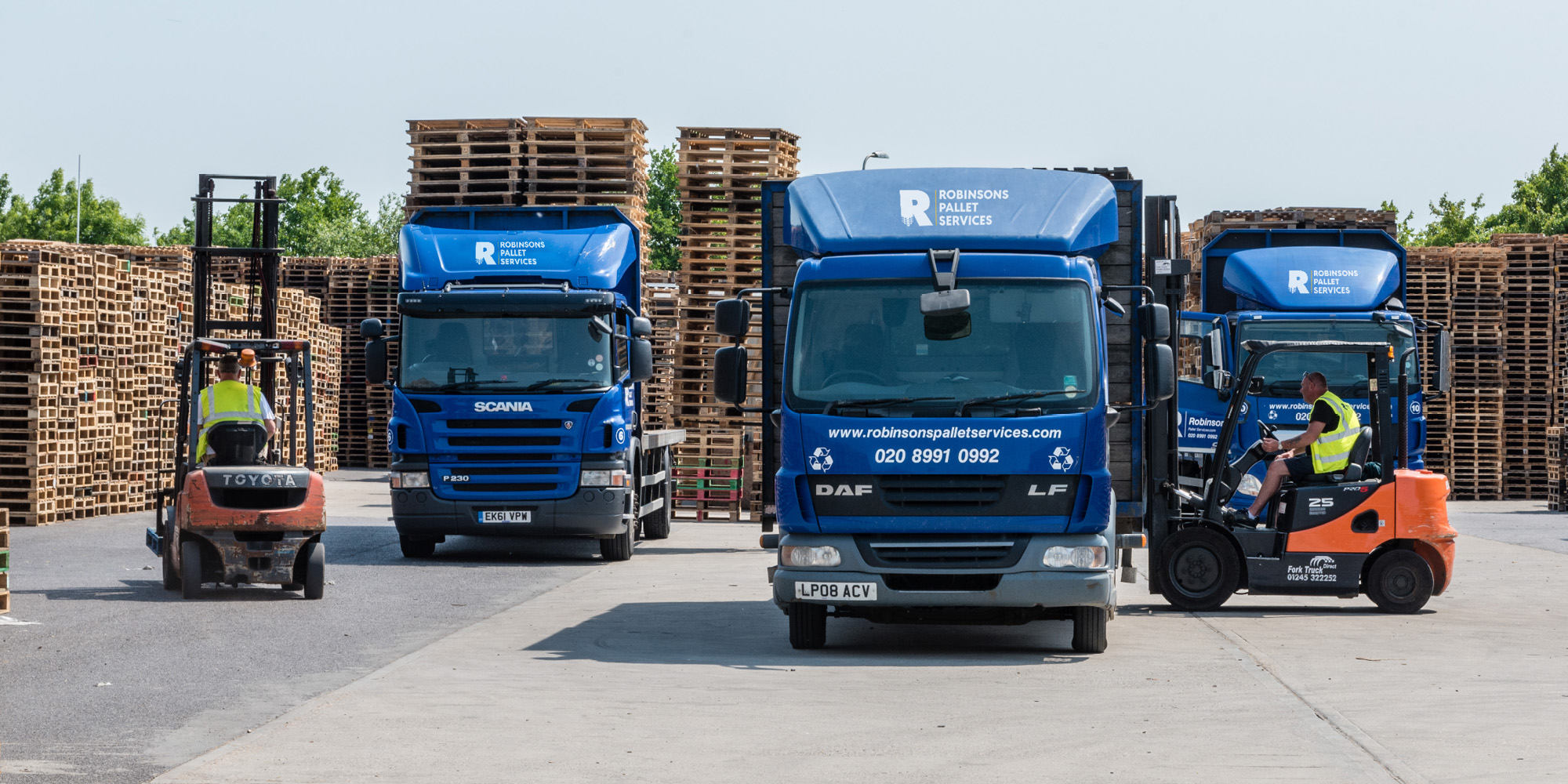
How to store wooden pallets safely, legally and efficiently
When unused pallets start accumulating in warehouses and construction sites, they can become more than a storage problem.
Poorly stacked pallets can create hazards for workers and obstruct access routes. They can also be a fire risk. The consequence for businesses is often disruption to daily processes and potential issues with insurance. You may also fall short of your fire-safety compliance obligations.
In this blog, we look at the best way to store wooden pallets safely, so that you avoid any unnecessary complications with compliance.
Why pallet storage matters
Good pallet storage is about more than keeping the site tidy. The Health and Safety Executive (HSE) stresses the importance of stable, well-managed storage and safe workplace transport arrangements. Its guidance recommends that stacks are neat, vertical, level and stable, with safe height limits clearly defined.
Fire risk is another important consideration. Wooden pallets can be combustible, so storing large quantities can add to the available fuel if a fire breaks out. HSE construction guidance specifically identifies wood as a potential source of fuel and recommends keeping combustible materials to the minimum necessary and storing them safely.
That makes pallet management relevant to your fire risk assessment. Pallet storage should therefore be considered as part of your wider fire risk assessment, helping to ensure that you’ve identified the risk and are taking steps to minimise it.
Check whether your insurance policy places any restrictions on the quantity of unused pallets or combustible material that can be stored on your premises, rather than assuming a particular quantity is automatically acceptable.
Indoor vs outdoor pallet storage
There is no universally correct answer to whether pallets should be stored inside or outside. The right choice depends on your premises and your activities. Consider how much space you have available, how frequently pallets are moved and what your fire risk assessment identifies.
Indoor storage protects pallets from rain and prolonged exposure to the elements, which can help preserve reusable stock. However, bringing large quantities of timber into a warehouse increases the amount of potentially combustible material inside the building. Storage must also avoid obstructing escape routes, fire doors, equipment or sprinkler systems.
Outdoor storage can keep surplus pallets out of the main building and may make collection and stock management easier. However, outdoor stacks still need to be stable, protected from unauthorised access and positioned appropriately in relation to buildings, ignition sources and other combustible materials.
On construction sites, HSE recommends designated, secure areas for materials and waste and reducing the amount of combustible material stored on site where possible.
Pallet stacking guidelines: how to store wooden pallets safely
A safe stacking system should start with the condition and type of pallet. Remove broken or badly damaged pallets from reusable stacks, as these could cause the entire stack to fall.
As a general best-practice approach:
- Stack pallets on a firm, level surface capable of supporting the load.
- Keep stacks straight, vertical, level and stable.
- Use pallets that are in suitable condition and designed for the intended use.
- Establish a maximum stack height based on the pallet type, load, stability and site conditions.
- Keep pedestrian and vehicle routes clear.
- Position stacks so they cannot be struck by vehicles or handling equipment.
- Inspect stacks regularly, particularly after movement or adverse weather.
- Keep pallets away from ignition sources and areas where hot work takes place.
HSE’s pallet safety guidance recommends that the maximum height of a stack is no more than six times the narrowest dimension of the bottom pallet.
UK pallet storage regulations and fire safety
For businesses in England and Wales, the Regulatory Reform (Fire Safety) Order 2005 provides the framework for fire safety in non-domestic premises. The responsible person must carry out and regularly review a fire risk assessment and implement appropriate fire-safety measures.
Poorly arranged storage can increase the risk of fire and may interfere with fire-protection measures.
Construction sites have additional considerations. The Fire Safety Order covers general fire safety on construction sites, while the Construction (Design and Management) Regulations 2015 also impose duties relating to fire risk, such as the duty to prevent fires on site.
When is it time to arrange pallet collection?
A useful warning sign is when pallets are accumulating faster than they are being reused or removed. You may have too many if:
- stacks are spreading into operational areas
- access or vehicle routes are becoming restricted
- pallets are being stored wherever space is available rather than in designated areas
- stacks are becoming unstable or difficult to inspect
- damaged pallets are accumulating
- your fire risk assessment no longer reflects the quantity being stored
- employees are regularly moving pallets simply to create more storage space.
At that point, collection can be safer and more efficient than continuing to expand your storage footprint.
Robinsons Pallet Services’ pallet collection service offers one-off and regular pallet clearances, including collections from construction sites. We can arrange regular collections for you if your business has an ongoing surplus. Regular collections can help you manage surplus pallets more effectively and support a safer, more organised approach to storage.
If surplus pallets are taking up valuable space at your site, speak to Robinsons Pallet Services about arranging a one-off or regular pallet collection.
Get in touch
Visit our products page to choose your preferred pallet grade. Then, contact us with the quantity you need and your delivery address for a seamless ordering process.


Email us
sales@robinsonspalletservices.com