Robinson Pallet Services

  • Pallets For Sale
  • Pallet Collection
  • Sustainability
  • News
  • About
  • Contact

Where can I sell wooden pallets near me?

June 5, 2026 by Ray

Where can I sell wooden pallets near me?

If your warehouse, depot, construction site, or distribution centre has surplus wooden pallets taking up valuable space, you may be looking for a way to clear the decks and make some money on those pallets.

Many businesses accumulate pallets over time as a result of incoming deliveries, stock movements, or changing operational requirements. While a few pallets may not cause any issues, larger quantities can quickly become difficult to manage and can take up valuable space that could be used more productively.

Rather than paying for waste removal or arranging costly disposal services, many businesses choose to sell their surplus pallets. Not only does this help free up space, but it can also generate additional revenue from assets that would otherwise sit unused.

At Robinsons Pallet Services, we buy wooden pallets from businesses across England and offer fast, reliable pallet collection services from our depots in Wembley and Witham.

Why sell your excess wooden pallets?

Unused pallets can quickly become a problem for businesses. Large quantities of pallets can:

  • Take up valuable warehouse and yard space
  • Create health and safety hazards
  • Make loading and unloading areas less efficient
  • Increase site clutter and reduce productivity


For busy warehouses and distribution centres, space is often at a premium. Every square metre occupied by unwanted pallets is space that could be used for stock storage, vehicle movements, or operational activities. In some cases, accumulated pallets can even create obstacles that affect day-to-day efficiency.

Selling your excess pallets allows you to reclaim that space while ensuring the pallets are reused or recycled responsibly. Instead of allowing pallets to accumulate, selling them can help you recover value while keeping your premises organised, safe, and efficient.

Looking for pallet buyers near Wembley or Witham?

If you’re searching online for pallet buyers near you, Robinsons Pallet Services can help.

We operate from two strategically located depots:

  • Wembley, Middlesex
  • Witham, Essex

These locations enable us to provide pallet collection services across London, the South East, East Anglia, and throughout much of England.

Whether your business is based in a busy industrial estate, a logistics hub, a retail distribution centre, or a manufacturing facility, our team can assess your pallet stock and advise on the best collection solution.

We work with businesses of all sizes and regularly handle both one-off pallet clearances and ongoing pallet collections. If your business generates a continuous supply of surplus pallets, we may be able to arrange regular collections to help prevent stock from building up on site.

How to sell your wooden pallets

Getting a quote is straightforward and only takes a few minutes.

Simply email collections@robinsonspalletservices.com and include:

  • A photo of the pallets you want to sell
  • The quantity of pallets you have available
  • Your location

Providing photographs helps our team identify the pallet types and assess their condition, while the quantity and location information allow us to determine collection requirements.

Once we receive your information, our team will review the details and provide a quote based on the pallets available.
If you’re happy with the price we offer, we’ll arrange a convenient time to collect the pallets from your site. Our aim is to make the process as simple and hassle-free as possible, allowing you to clear unwanted pallets without disrupting your operations.

What types of businesses do we work with?

We regularly purchase pallets from a wide range of industries and business sectors, including:

  • Warehouses
  • Distribution centres
  • Manufacturers
  • Retail businesses
  • Construction sites
  • Logistics companies
  • Importers and exporters

Many of these businesses receive large volumes of goods on pallets and can quickly accumulate surplus stock. Rather than allowing these pallets to take up valuable space, they choose to sell them for reuse and recycling.

Whether you have a one-off clearance following a warehouse reorganisation or ongoing pallet requirements as part of your normal operations, we can create a collection plan that works for your business.

Do you need a minimum number of pallets?

For one-off pallet clearances, we generally look for larger quantities of pallets. Typically, we request a minimum of 100 pallets for one-off collections. However, collection requirements can vary depending on your location and the type of pallets available.

If you’re unsure whether your pallet quantity meets our collection requirements, it’s still worth getting in touch. Our team can review your photos and quantities and advise on the most suitable option.

We can also often accommodate regular collection arrangements for businesses generating ongoing pallet stock. In many cases, a scheduled collection service can help businesses avoid pallet build-ups and keep their sites operating efficiently.

Why choose Robinsons Pallet Services?

With decades of experience in pallet recycling and recovery, Robinsons Pallet Services helps businesses turn unwanted pallets into value while supporting a more sustainable supply chain.

We offer:

Fast response times
Competitive pallet valuations
Reliable collection services
Regular and one-off pallet clearances
Experienced pallet recycling specialists

Our Wembley and Witham depots allow us to efficiently collect pallets across a wide geographical area, helping businesses keep their sites clear, organised, and operational.

By choosing Robinsons Pallet Services, you’re working with an experienced pallet specialist that understands the needs of warehouses, logistics providers, manufacturers, and other commercial operations.

Get a quote today

If you want to find someone near you to buy your unwanted pallets, we can help.

Email collections@robinsonspalletservices.com with:

  • A photo of your pallets
  • The quantity available
  • Your location

We’ll provide a quote and, if you’re happy to proceed, arrange a convenient collection time for your pallets.

Filed Under: Uncategorized

What is the difference between Grade 1, Grade 2 and Grade 3 pallets?

June 5, 2026 by Ray

What is the difference between Grade 1, Grade 2 and Grade 3 pallets?

The difference in grading denotes the difference in quality between the pallets. Grade 1 pallets are in the best condition, whereas Grade 3 pallets are heavily worn.

Each grade can be used for slightly different purposes and come with varying price points.

Choosing the wrong pallet grade can lead to unnecessary expenses or performance issues, especially if your business handles heavy loads, high-volume warehousing, or regular transportation.

In this guide, we’ll break down the differences between Grade 1, Grade 2, and Grade 3 pallets, explain where each performs best, and help you decide which option is right for your operation.

Grade 1 pallets: best for heavy loads

Grade 1 pallets are considered the highest quality option available in the used or recycled pallet market. These pallets are typically in excellent condition, with little to no visible damage, clean timber, and strong structural integrity.

They are often repaired to a very high standard or may have seen only limited prior use. Because of this, Grade 1 pallets are ideal for businesses that need reliability, durability, and a professional appearance.

Common uses: high load bearing

Warehouse managers commonly choose Grade 1 pallets for:

  • Heavy product storage
  • Racking systems
  • Export shipments
  • Retail-facing logistics
  • High-turnover warehouse environments

One of the biggest advantages of Grade 1 pallets is their load-bearing capability. They are designed to cope with substantial weight while maintaining stability during transport and storage. This makes them particularly useful for industries such as manufacturing, construction supplies, beverages, and bulk goods distribution.

Uniform dimensions

Another benefit is consistency. Since Grade 1 pallets are usually uniform in quality and dimensions, they work well with automated warehouse systems and forklifts, reducing the likelihood of handling issues.

Cost reflects the quality

While Grade 1 pallets come at a higher price point than lower grades, many businesses view them as a worthwhile investment because they typically last longer and require fewer replacements over time.

If your operation depends on strength, safety, and presentation, Grade 1 pallets are usually the safest choice.

Grade 2 pallets: best for general warehousing

Grade 2 pallets sit comfortably in the middle ground between premium quality and cost efficiency. They may show signs of previous use, including minor cosmetic wear or small repairs, but they remain structurally sound and highly functional.

For many warehouse operations, Grade 2 pallets offer the best balance of performance and affordability.

Common uses: general warehousing and transport

These pallets are commonly used for:

  • General warehouse storage
  • Day-to-day distribution
  • Internal logistics
  • Medium-weight loads
  • Standard transport operations

Because Grade 2 pallets are more affordable than Grade 1 options, they are particularly popular with businesses managing large pallet volumes. They still provide dependable performance without the higher upfront investment associated with premium-grade pallets.

In most warehouse settings, Grade 2 pallets are more than capable of handling regular operational demands. They are suitable for forklift handling, stacking, and routine transportation, making them a practical all-round solution.

Flexibility and versatility

Another reason businesses choose Grade 2 pallets is flexibility. They can be used across a wide variety of industries, from food distribution and retail warehousing to manufacturing and e-commerce fulfilment.

For companies looking to balance durability with budget considerations, Grade 2 pallets are often the sweet spot.

Grade 3 pallets: best for one-way transport

Grade 3 pallets are the most economical option and are generally intended for lighter-duty applications. These pallets often show clear signs of wear and may have undergone multiple repairs throughout their lifespan.

Although they are still usable, Grade 3 pallets are not designed for long-term heavy-duty use or demanding warehouse environments.

Common uses

Instead, they are best suited for:

  • One-way shipping
  • Export transport
  • Lightweight goods
  • Temporary storage
  • Short-term logistics use

Businesses often choose Grade 3 pallets when pallet return is unlikely or when minimising upfront cost is the main priority. For example, if products are being shipped internationally or sent directly to customers without pallet recovery, investing in higher-grade pallets may not make financial sense.

The lower cost of Grade 3 pallets can make them highly attractive for short-term logistics projects or disposable transport requirements.

Shorter lifespans

However, there are trade-offs to consider. Grade 3 pallets generally have a shorter lifespan and lower weight capacity compared to Grade 1 or Grade 2 pallets. They may also vary more in appearance and condition, which can affect compatibility with automated systems or customer-facing operations.

For lightweight, one-way transportation needs, though, Grade 3 pallets remain a cost-effective solution.

Overall analysis: what’s right for you?

The best pallet grade for your business ultimately depends on how the pallets will be used.

If your operation involves heavy products, long-term warehousing, or demanding transport conditions, Grade 1 pallets offer the highest level of durability and reliability. They are ideal for businesses where safety and performance are critical.

If you need a dependable all-round pallet for everyday warehouse operations without stretching your budget, Grade 2 pallets are often the most practical choice. They deliver strong performance at a more affordable price point and suit a wide range of industries.

Meanwhile, Grade 3 pallets are perfect for businesses focused on low-cost, one-way transportation or temporary logistics solutions. While they may not provide the same longevity, they can help reduce shipping costs where pallet recovery is not necessary.

Before making a decision, it’s important to consider factors such as load weight, storage systems, transport frequency, and pallet lifespan. Taking the time to match the right pallet grade to your operational needs can improve efficiency, reduce damage, and save money in the long run.

Whether you’re managing a busy warehouse or organising regular transport deliveries, choosing the correct pallet grade is a simple step that can make a significant difference to your overall logistics performance.

Talk to the experts

If you’d like any guidance on which pallets to use, or you’d like to talk to us about pricing options, please get in touch.
You can call Robinsons Pallets on 01376 516 742 (Essex) or 020 8991 0992 (London) or email us at sales@robinsonspalletservices.com

Filed Under: Uncategorized

How to choose the right wooden pallets for your business

April 17, 2026 by Ray

How to choose the right wooden pallets for your business

Choosing the right wooden pallets takes some thought for any business involved in warehousing, logistics, or manufacturing. Making the right choice can improve efficiency, reduce costs, and protect your goods throughout the supply chain.

At Robinsons Pallet Services, we work closely with businesses across the UK to ensure they get pallets that meet both operational and budget requirements. This guide will help you understand what to look for when selecting the right pallets for your business.

Why choosing the correct pallet type matters

Not all pallets are created equal, and choosing the wrong type can lead to damaged goods, inefficiencies in storage, and increased transport costs.

The right pallet should:

  • Support the weight of your goods without risk of breakage
  • Fit seamlessly into your storage and racking systems
  • Comply with shipping and export requirements
  • Optimise space during transport

For example, a manufacturer shipping heavy machinery parts will need a very different pallet specification compared to a retailer distributing lightweight packaged goods.

Common pallet sizes used in the UK

Pallets come in different shapes and sizes and their dimensions directly impact storage, transport, and compatibility with logistics systems.

Some of the most common pallet sizes in the UK include:

  • 1200mm x 1000mm (UK standard pallet)
    Widely used across industries and ideal for general-purpose storage and distribution.
  • 1200mm x 800mm (Euro pallet)
    Common in European supply chains and compatible with many international shipping systems.
  • 1200mm x 1200mm (square pallet)
    Often used for bulkier or heavier goods.
  • Custom sizes
    Many businesses require bespoke pallets tailored to specific products or handling systems

The right size for your business will depend on your warehouse space, and how you intend to load your vehicles. If you’re not sure which size is right for you, we can advise.

Differences between Euro pallets and UK pallets

One of the most common areas of confusion for buyers is the difference between Euro pallets and UK pallets. Many businesses can use either size, but the Euro pallets tend to be preferable if you’re transporting goods abroad.

Euro pallets (1200mm x 800mm):

  • Standardised across Europe (EPAL specification)
  • Ideal for international transport
  • Often required for certain European supply chains
  • Typically lighter and slightly narrower

UK pallets (1200mm x 1000mm):

  • More common in domestic UK operations
  • Offer greater surface area for goods
  • Better suited for UK warehouse racking systems
  • Often used in retail and general distribution

If your business operates both domestically and internationally, you may need a mix of both pallet types. A knowledgeable pallet supplier can help you balance these requirements efficiently.

New vs recycled pallets

Another key decision when purchasing wooden pallets is whether to choose new or recycled options.

Why choose new pallets

New pallets can be manufactured to your exact specifications. So if you have unusual loads, or specific storage requirements, you may prefer new pallets. We can make them consistent in quality and appearance.

New pallets are usually more suitable for industries with strict compliance standards.

Why choose recycled pallets

The majority of businesses use recycled pallets. Generally this is because they work out cheaper, but they’re also the environmentally-friendly option.

Recycled pallets are suitable for lighter loads or one-way shipments, and they’re available in a range of grades depending on condition.

A mixture of new and recycled may work best

For many businesses, a combination of new and recycled pallets offers the best balance between cost and performance. Robinsons Pallet Services supplies both options, ensuring customers can choose what works best for their operations and sustainability goals.

When businesses should consider bulk pallet purchases

Buying pallets in bulk can provide significant advantages, particularly for businesses with ongoing logistics needs.

You should consider bulk purchasing if:

  • You have consistent shipping or storage requirements
  • You want to reduce per-unit costs
  • You need a reliable, steady supply of pallets
  • You aim to standardise pallet types across operations

Bulk orders can also help us understand your business needs and pre-empt what you might need. For example, we can work out your specific pallet sizes, regular delivery schedules, or customised designs.

How to choose?

Selecting the right wooden pallets is about more than just price. It’s about finding the right combination of size, strength, and suitability for your operations. When you know the differences in pallet types, sizes, and conditions, you can make informed decisions that improve efficiency and reduce long-term costs in your businesses.

At Robinsons Pallets, we have industry expertise and a wide range of pallet options to help you find the perfect solution.

Filed Under: Uncategorized

Different wooden pallet types (and how to choose the right one)

November 28, 2025 by Ray

Different wooden pallet types (and how to choose the right one)

A pallet is a pallet, right? You load them up and they do they job.

To an extent, you might get away with that. But if you pick the right pallets for the right job, your business becomes more efficient and you’ll avoid any mis-haps.

4-way or 2-way pallets

You can use pallets more efficiently when you know if a 4-way or a 2-way pallet is best for your warehouse.

Pallets with 4-way entry can be moved by a forklift from any side. 2-way pallets on the other hand have two solid sides and two open sides. That means that forklifts generally need more space to move 2-way pallets around the warehouse.

We often provide 4-way pallets to clients in the logistics and retail industries. But that doesn’t mean they’re limited to those industries They’re very versatile.
2-way entry pallets tend to be a little cheaper, so if you’re looking to reduce spend, and space isn’t a problem, then 2-way pallets may serve you best.

Choosing a grade

The grade of the pallet dictates the weight of the load it can carry.

  • Grade 1 can hold the most weight. That’s usually around 1,000kg for a UK pallet.
  • Grade 2 can hold approximately 750kg.
  • Grade 3 is the lightweight option that holds between 200kg and 500kg.

Once you know roughly how your loads are split in terms of weight, you can choose the right Grade of pallet.

Euro or UK size?

Pallets generally come in two standard sizes: Euro or UK.

  • Standard Euro pallets are 1200 x 800mm
  • Standard UK pallets are 1200 x 1000mm

This may be much of a muchness if you have acres of space in your warehouse. But choosing either Euro or UK pallets can maximise space and efficiencies.

If you’re exporting around Europe then it’s best to choose the standard Euro pallets, as they’re designed to fit most European door frames and property sizes. They’re also stamped with the official European stamp, which means they’re universally accepted throughout Europe and you won’t face any difficulties with your exports.

Stacking or racking?

If you’re stacking your pallets in your warehouse, then you use the space best when the pallets sit flush. For that to work, you need pallets with a perimeter base.
If you’re racking pallets in a warehouse, then you may get on better with pallets that have legged or strapped bases. Our legged pallets are ideal for handling with a manual or electric pump truck, so if you have those in your warehouse, the legged pallets would be a good choice.

Delicate cargo?

You can protect a delicate load with collars on each side of your pallet. A collar stops the goods from moving around during transport. They’re not mandatory, but they add a layer of protection if you’re concerned about fragile loads.

If you’re exporting abroad…

Remember that if you’re exporting your goods abroad, then your pallets must be heat-treated to ISPM 15 regulations. Most of our pallets reach this standard anyway, but please let us know if you need heat-treated pallets. If you’re not sure, we can advise.

Need more guidance?

Head over to our guide , where you’ll find more information on wooden pallets, plastic pallets, or pallets with a collar.

Filed Under: Uncategorized

Safety Tips for Upcycling Wooden Pallets in Home Projects

May 13, 2025 by Ray

Safety tips for upcycling wooden pallets in home projects

The humble wooden pallet has become a bit of a celebrity in the world of design, thanks to creative whizzes posting their upcycled masterpieces on sites like Pinterest.

We’ve seen our basic pallets turned into garden furniture, wine racks, bedside tables, outdoor benches, bike racks, signage, and much more.
It’s a delight to see pallets being reused in such fun and interesting ways. And it’s so much more satisfying than sending them to landfill. We’re all on board with these projects!

Without being a spoil sport, there are a few safety issues with pallets. We mention it only to make sure that your home projects are a roaring success.
These are the safety tips that you need to know about your pallets before you begin your project.

Check the marking on the pallet

If the pallets have been used in international transport, they’ll have certain markings on them. Once you know how to de-code these markings, you know if you’ve found pallets that are safe to use.

What you’re looking for is a heat-treated pallet. Wood that is treated with heat is less susceptible to moisture, and has less chance of developing rot or mould.
But even more important than that, it hasn’t been treated with a toxic pesticide called methyl bromide. Back in the day, pallets were treated with methyl bromide to cleanse them from bugs and pests. But the pesticide is harmful to humans and it has not been used since 2010. So any pallet which has the marking for methyl bromide (MB) is not only toxic, but also very old. Not ideal for your home projects!

Heat-treated pallets will be marked with ‘HT’. They should also have the Integrated Pollution Prevention and Control (IPPC) logo on it somewhere. These pallets are a good choice for your project.

Below is a table of other markings that you might come across, together with an indication of whether or not they are safe to use:

Pallet treatment codes    
Code Meaning Safe to use?
DB Debarked Yes
HT Heat treated Yes
KD Kiln dried Yes
EPAL European Pallet Association Logo Yes
EUR Old European Pallet Association Logo No, unless it is EPAL approved
MB Methyl Bromide No
Coloured pallets   No

You might find a pallet that has no markings on it whatsoever. That means that it has been transported within the UK and has not crossed borders. These should be safe to use, but there is no guarantee that they have been treated with heat. If possible, ask your supplier.

Find out what the pallet was used for

See if you can find out what your chosen pallet was used for. Ideally you’re looking for pallets that were used to transport dry cargo.

Steer clear of pallets that have been used to transport food or chemicals. These pallets are often contaminated with traces of their loads. Pallets that have carried food are known to be vulnerable to E.Coli and other bacteria that can soak into the wood. Similarly, harmful chemicals can end up in the pallet wood from their loads.

How to spot mould

Rotten or mouldy pallets should be avoided at all costs. But it’s not always obvious that the pallet is rotting inside. Things to look for are: evidence of splitting in the wood, or areas of wood that are flaking off.

Safeguard against bugs

Bugs are usually attracted to moisture in the wood, so if you have damp wood you could run the risk of an infestation. As we said earlier, heat-treated pallets are less likely to absorb moisture, so you should be on safe ground with a pallet treated by heat.

The other things you can do are protect your wood with paint, stain or sealant to deter any unwanted guests.

Best projects for wood pallets

The best projects for wooden pallets are those that you will keep outdoors, such as a bike rack, compost bin, or signage. That minimises the risk of any contamination in your home.

Just be careful if you’re using them to grow food in though. Make sure you know the background to your pallets if you’re doing this.

If you’re using pallets indoors, then it’s wise to get them from a trusted source, so that you know how they’ve been treated, and what they’ve been used for.

Looking for pallets?

If you’d like pallets for your home projects, please give us a call. We’d be happy to arrange some pallets for you, which will be safe and suitable for your project.

Filed Under: Uncategorized

How do you get wooden pallets collected?

April 7, 2025 by Ray

How do you get wooden pallets collected?

A surplus of wooden pallets at your facility can take up valuable space, and create an additional health & safety burden that you could probably do without.

How do you get your pallets collected in the most efficient and environmentally-friendly way?

At Robinsons Pallet Services, we offer three simple services for pallet collection:

  • One-off pallet collection
    We collect pallets in a one-off clearance, so long as there are at least 100 pallets on your site. If you’re local, we can often do a collection for fewer than 100 pallets.
  • Regular pallet clearance
    We can visit your site at a regular time and date to keep your site free of surplus pallets.
  • Pallet purchasing
    We partner with pallet suppliers and offer exceptional rates for good quality stock that has already been graded.

How do you get rid of wooden pallets?

There are a variety of options to get rid of your surplus wooden pallets, and it probably depends on how many pallets you have spare, and how convenient each option will be for you.

  • Arrange for them to be collected by a supplier, like us
    As a business, we estimate that we need over 50,000 pallets a week, so we’re always on the lookout for spare pallets. And we pay highly-competitive rates for them.

    This way, you’re contributing to the circular economy, and you’ll be remunerated for your pallets. There’s minimal hassle for you – you just give us a call and we’ll arrange collection.
  • Take them to a recycle centre
    Most industrial recycle centres will take used wooden pallets. Again, they’re unlikely to pay you for them. And some of your pallets may end up in landfill.

    If your pallets are still in a usable condition, this may be the least environmentally-friendly option.
  • Sell or giveaway on online marketplaces
    There are plenty of people in the market for wooden pallets online. However, there’s no guarantee that you’ll get a competitive price for them, and it could be logistically complex if you have multiple buyers for your pallets. Equally, it’s quite a time-consuming process for you to go through.
  • Donate to local groups
    Local community groups like Scouts or allotment groups may be interested in taking the pallets off your hands. They can repurpose the pallets for furniture, garden beds, or compost bins.

    The benefit of this is that you’re minimising your waste as a business and supporting local groups, which contributes to the ‘feel good’ factor of your business. The downside is that you’re unlikely to receive any money for your pallets, and there’s a bit of legwork to do in ringing around to gauge interest.

    You’ll probably only get rid of a few pallets this way, so if you have hundreds in excess, then this won’t be viable.

The do’s and don’ts of pallet collection

We often get questions about the condition of pallets, and how to store them while they await collection. Here’s a short list of do’s and don’ts when it comes to pallet collection.

Do:

  • Make money from your used pallets.
    You don’t have to give them away. We’ll pay you for them.
  • Create a partnership for regular clearance
    This takes away all the hassle on larger sites. We pick them up at regular intervals so your site stays clear of surplus pallets.
  • Store pallets properly before collection
    Keep them in a dry area that’s well ventilated. Stack them evenly on a level surface, otherwise the wood can warp, compromising the structural integrity.
  • Be ready for the collection
    Be on site and organised and this will save time and money.

Don’t:

  • Throw away pallets in bad condition
    We can recondition pallets to make something new out of the old ones. Or we can use them as woodchip. There are plenty of ways to reuse and recycle pallets that are in bad condition. They don’t need to go to landfill.
  • Let pallets become overwhelming on your site
    Pallets take up a lot of space on a site. And they can become a health & safety hazard if you have too many and restricted storage space. Get them collected before they become a problem.

How we can help

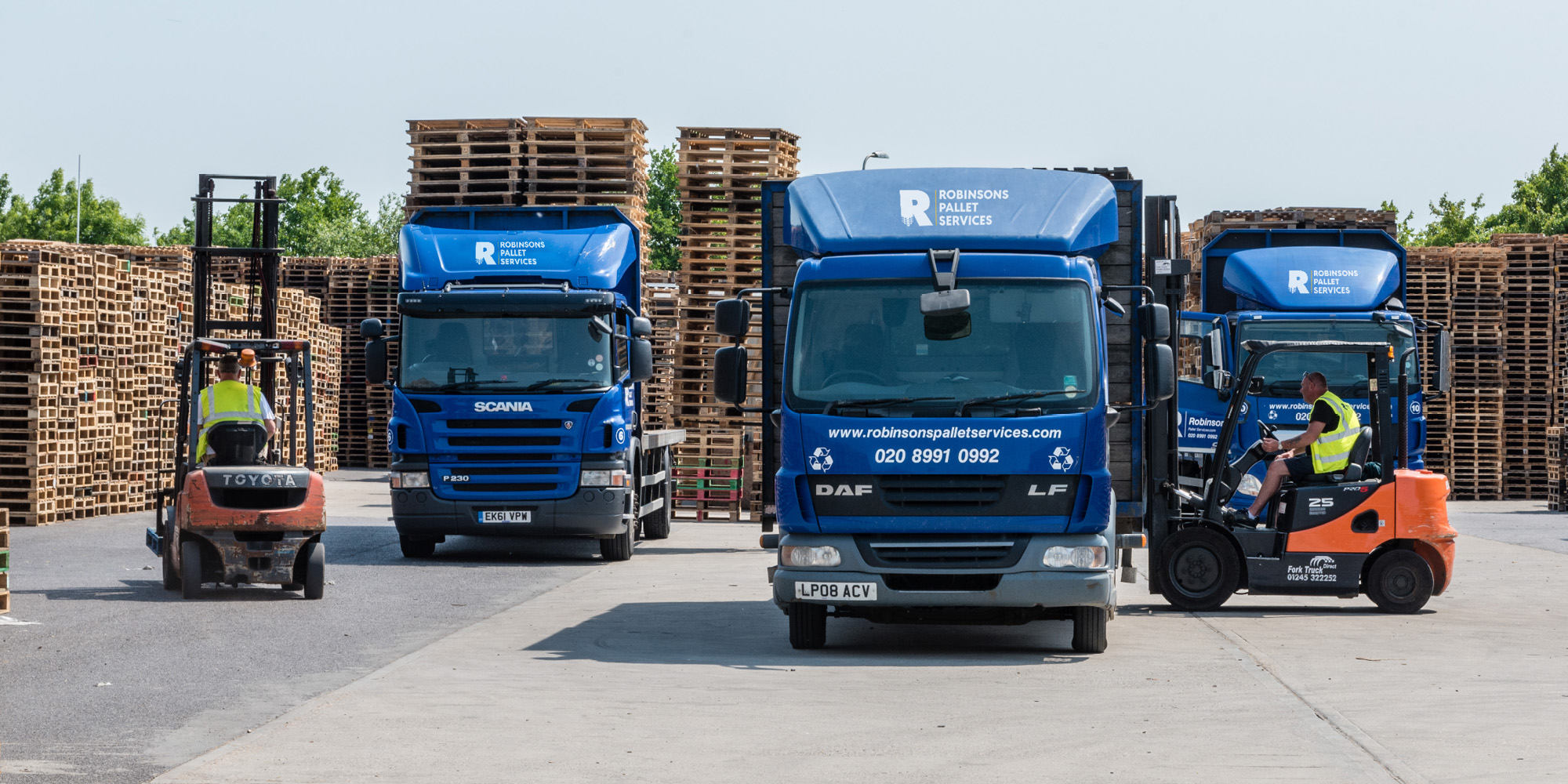
We buy pallets all year round and we have our own fleet of purpose-built vehicles to come and collect them from you. Get in touch with us at collections@robinsonspalletservices.com to arrange collection. We’ll give you a competitive price and organise a time to visit your premises.

Filed Under: Uncategorized

New vs. used pallets for sale: Which is the better option?

March 6, 2025 by Ray

New vs. used pallets for sale: which is the better option?

When you’re looking to buy or hire pallets for your business, you’ll see that there are more options out there than you might have first thought!

A good place to start is to decide whether you want to buy new or used pallets.

Why buy new pallets?

The reason you might buy your pallets new is if you’re transporting hygiene-sensitive products. That’s usually things like food or pharmaceuticals.

With those sort of products, you want to reduce any risk of contamination as far as possible. While used pallets are generally clean and hygienic, we cannot completely eradicate the risk of contamination, and so new pallets are usually the right choice for transporting these goods.

You may also choose new pallets if you need an unusual size and shape. Used pallets are usually standard shapes and sizes that work with UK and European logistics. In the vast majority of cases, this is exactly what you need. But for unusual loads, you might require bespoke pallets. We’re able to prepare new pallets in bulk if you need them.

In a similar vein, if your load is particularly heavy then you may opt for new pallets. Reconditioned pallets are checked for vulnerabilities and regularly fortified, but new pallets will generally have a higher structural integrity to carry very heavy loads.

Additionally, pallet standards and quality control are essential in logistics, and organizations like the European Pallet Association (EPAL) ensure compliance with strict quality guidelines for pallet manufacturing and safety.

Why you would choose used pallets

The main reason to choose used pallets is for cost reasons. Used pallets are around 60% of the cost of new pallets, so it saves you a lot of money.

Reused pallets are repaired regularly to prolong their lifespan and to make sure that they are always fit for purpose. They come in the standard sizes and reliably ‘do the job’ for most business purposes

We can guarantee that they’re always available too. We always have stock in for reconditioned pallets so you have access to affordable, reused pallets whenever you need them, even if it’s at short notice.

The environmental considerations

There are arguments on both sides for the environmental reasons for choosing new or used pallets.

The majority of our pallets are reconditioned, which means that they are made from recycled wood. The wood that may have been thrown away or otherwise discarded ends up in our pallets. Equally, there’s no need to fell more trees, because we only use the wood that’s in circulation. We estimate that we usually recycle around 2 million pallets per year, which saves around 50,000 trees.

On the other hand, new pallets are now made from sustainably-sourced timber these days. That means that the forests they come from are managed responsibly and they balance the needs of the environment, wildlife, and forest communities. So new pallets are made with sustainability in mind.

We understand that lots of businesses are now looking to achieve or maintain B Corp© status, or you need to report your environmental impact in an ESG report.

Whether you choose new or used pallets, you can justify your decision with reference to the considerations you’ve given to your environmental performance. Investing in reused pallets shows your commitment to the circular economy. But if the load you’re carrying means that new pallets are the best option for you, then you can say that you only buy pallets that are made from sustainably-sourced timber.

How we can help

If you’d like to chat to an expert about which pallets are most suitable for the load you want to carry, please get in touch. We’re happy to talk you through the options and make a suggestion for you, with an estimate of the projected costs.

Filed Under: Uncategorized

Get in touch

Visit our products page to choose your preferred pallet grade. Then, contact us with the quantity you need and your delivery address for a seamless ordering process.

Call us

Wembley:
020 8991 0992

Witham:
01376 516742

Email us

sales@robinsonspalletservices.com

Contact

Wembley Depot’s Opening Hours
Monday – Friday – 6am – 3:45pm
Saturday (by appointment only) – 7am – 11am

Witham Depot’s Opening Hours
Mon – Fri – 7am – 4.45pm

© 2026 Robinsons Pallets. All rights reserved.

  • Cookie Policy
  • Privacy Policy
    • Pallets For Sale
    • Pallet Collection
    • Sustainability
    • News
    • About
    • Contact